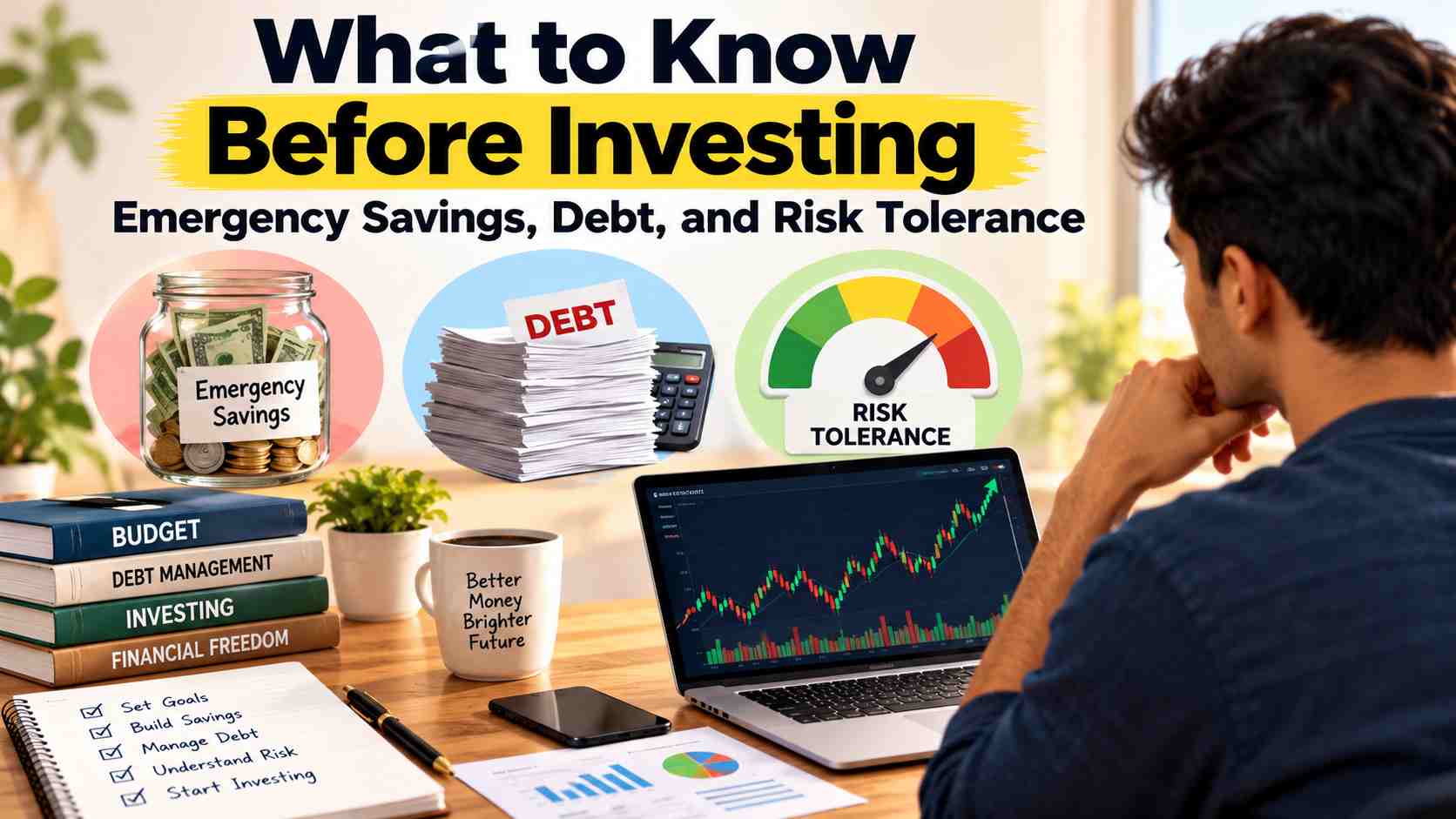
Investing can be an effective way to build wealth, prepare for retirement, and achieve long-term financial goals. Whether you want to invest in stocks, exchange-traded funds (ETFs), mutual funds, bonds, or other assets, getting started can feel exciting. However, investing without a solid financial foundation may expose you to unnecessary risks.
Before putting your money into the stock market, it is important to understand three essential things: your emergency savings, your existing debt, and your risk tolerance.
These factors influence how much money you can afford to invest, how you should prioritize your financial goals, and how comfortably you can handle market fluctuations. A strategy that works for someone with stable income and no debt may not be suitable for someone with high-interest loans or unpredictable earnings.
This guide explains what to know before investing, how to prepare financially, and how to make decisions that align with your circumstances.
1. Build Emergency Savings Before Investing
An emergency fund is money set aside for unexpected expenses, such as medical bills, urgent home repairs, job loss, or an essential vehicle repair. Its primary purpose is to help you manage financial emergencies without relying on credit cards, personal loans, or selling investments at an unfavorable time.
How much emergency savings do you need?
A common financial planning guideline is to keep approximately three to six months of essential living expenses in an emergency fund. The appropriate amount depends on your income stability, household responsibilities, insurance coverage, and access to other reliable financial resources.
For example, if your essential monthly expenses are $2,000, a three-to-six-month emergency fund would range from $6,000 to $12,000.
In India, if your essential monthly expenses are ₹30,000, the same guideline suggests an emergency fund of ₹90,000 to ₹1,80,000.
These are illustrative calculations, not universal requirements. Someone who is self-employed, supports dependents, or has irregular income may need a larger reserve. A person with stable employment and strong insurance coverage may be comfortable with a smaller initial target.
Where should you keep emergency savings?
Emergency money should prioritize accessibility and capital preservation rather than high returns. Depending on your country and circumstances, suitable options may include:
- A savings account with convenient access to funds.
- A bank account offering competitive interest and appropriate deposit protection.
- Short-term deposits that can be accessed without excessive penalties, where suitable.
- A combination of readily accessible cash and other relatively liquid savings.
In the United States, eligible deposits at FDIC-insured banks are generally insured up to $250,000 per depositor, per insured bank, per ownership category. In India, eligible deposits at insured banks are covered by DICGC up to ₹5 lakh per depositor per bank, including principal and interest, subject to the applicable rules.
Check the relevant protection limits and eligibility requirements before choosing an account.
Avoid treating stocks, cryptocurrency, or long-term investments as your primary emergency fund. Their values can fall precisely when you need the money.
Should you invest before completing your emergency fund?
You do not necessarily need to postpone every investment until you have saved six months of expenses. If your finances are stable, you have no expensive debt, and you are building your emergency fund consistently, you may choose to begin investing small amounts while continuing to save.
However, if you have no emergency savings and your income is uncertain, prioritizing a basic cash reserve is generally more prudent than committing substantial money to volatile investments.
The goal is to avoid being forced to sell investments or borrow money when an unexpected expense occurs.
2. Understand and Manage Your Debt
Debt is another important consideration before investing. Not all debt is harmful, but high-interest borrowing can make it harder to build wealth.
When deciding whether to invest or repay debt, compare the interest you pay on borrowing with the uncertain returns you might earn from investments.
Prioritize high-interest debt
Credit card balances, payday loans, and some personal loans can carry substantial interest rates. Paying down expensive debt can reduce future interest costs and improve your financial flexibility.
For example, suppose you have $5,000 in credit card debt charging 24% annual interest. If that balance remained outstanding for a year, the interest cost could be approximately $1,200 under a simplified calculation that ignores payments, compounding, and fees.
If you instead live in India and carry ₹1,00,000 in debt at an illustrative annual interest rate of 24%, the equivalent simple annual interest cost would be ₹24,000.
Repaying such debt can provide a relatively predictable financial benefit by avoiding future interest charges. By comparison, stock market returns are uncertain, and investments can lose value.
Your actual savings depend on the lender’s interest calculation, repayment schedule, fees, and applicable terms.
Choose a debt repayment strategy
Two popular approaches can help you organize repayment.
The debt avalanche method: Make required minimum payments on all debts, then direct additional money toward the debt with the highest interest rate. This approach generally minimizes interest costs when other terms are comparable.
The debt snowball method: Make minimum payments on all debts, then focus extra payments on the smallest balance first. Clearing smaller debts can provide motivation and a sense of progress.
Both approaches can work. The best choice depends on whether minimizing interest or maintaining motivation is more important for your circumstances.
Should you pay off every debt before investing?
Not necessarily. Low-interest, manageable debt does not always need to be eliminated before investing, especially when you have a long investment horizon and adequate savings.
For example, a fixed-rate education loan or mortgage may have a lower interest rate than unsecured consumer debt. The decision to repay it early should account for interest costs, tax treatment where applicable, liquidity needs, loan conditions, and your investment goals.
Also consider whether your employer offers a retirement plan contribution match in the United States. Depending on the plan and its terms, receiving the full match may be worthwhile while you repay debt, provided you can meet essential expenses and required debt payments.
For Indian investors, review loan terms, tax rules applicable to your situation, and any employer retirement benefits before making the decision.
The key principle is straightforward: avoid taking unnecessary investment risks while expensive debt continues to accumulate.
3. Determine Your Investment Risk Tolerance
Risk tolerance is your ability and willingness to accept losses or fluctuations in investment value.
It is one of the most important factors in choosing investments because financial markets do not move upward consistently. Stocks can experience sharp declines, bonds can lose value, and even diversified portfolios can have difficult periods.
Understanding your risk tolerance helps you select a portfolio you can realistically maintain during market downturns.
The three main risk profiles
Conservative investors prioritize stability and relatively limited fluctuations. They may prefer a greater allocation to cash equivalents and high-quality fixed-income investments, depending on their time horizon and financial needs. Their trade-off is that lower-risk portfolios may not generate enough growth to outpace inflation over long periods.
Moderate investors are willing to accept some market fluctuations in exchange for potential long-term growth. They may combine diversified stock investments with bonds and other assets appropriate to their circumstances.
Aggressive investors can generally tolerate substantial fluctuations and potential losses in pursuit of higher long-term growth. They may allocate a larger proportion of their portfolios to stocks, but aggressive investing does not guarantee higher returns.
These categories are starting points rather than rigid classifications. Your portfolio should reflect your goals, time horizon, and financial capacity to absorb losses.
Risk tolerance versus risk capacity
These concepts are related but different.
Risk tolerance describes how emotionally comfortable you are with investment losses. Risk capacity describes how much financial loss you can afford without jeopardizing essential goals.
For example, a young investor may feel comfortable taking substantial stock market risks but still have low risk capacity if they have unstable income, significant debt, and no emergency fund.
Another investor may feel anxious about volatility but have a long time horizon, stable income, and sufficient savings.
A sensible investment plan considers both factors rather than relying only on age or personality.
How to assess your risk tolerance
Ask yourself these questions before investing:
- How would I respond if my portfolio fell by 20%?
- Will I need this money within the next one to three years?
- Can I continue investing if the market declines?
- Do I have sufficient savings to cover unexpected expenses?
- Would an investment loss affect my ability to pay rent, a mortgage, or essential bills?
- Am I investing for retirement, a home purchase, education, or another goal?
Your answers can help determine whether you should prioritize stability, growth, or a balanced approach.
Never assume you can tolerate a large loss simply because you have not experienced one before.
4. Match Your Investments to Your Financial Goals
Before choosing an investment, define what you want your money to accomplish and when you will need it.
Your goal and time horizon influence the amount of risk you can reasonably take.
| Financial goal | General approach to consider |
|---|---|
| Emergency expenses | Accessible cash and suitable insured deposits |
| A major purchase within 1–3 years | Capital preservation and relatively low-volatility options |
| A goal in 3–7 years | A carefully balanced approach based on flexibility and risk capacity |
| Retirement in 10–30 years | A diversified portfolio designed for long-term growth |
| Wealth building without a fixed deadline | A diversified strategy aligned with your risk tolerance |
These time ranges are illustrative, not guarantees. Even investments held for many years can lose value, and some goals require more conservative planning than their timelines alone might suggest.
Why time horizon matters
Imagine that you are saving for a house deposit you will need in 18 months. Investing the entire amount in stocks could leave you with a substantial shortfall if the market declines just before the purchase.
Now imagine that you are investing for retirement that is 25 years away. You may have more time to recover from market downturns, although recovery is never guaranteed.
Separating short-term savings from long-term investments can help prevent market volatility from disrupting essential plans.
5. Diversify Instead of Betting on One Investment
Diversification means spreading investments across different assets, industries, companies, or markets rather than relying heavily on one investment.
For example, an investor who puts all their money into one technology stock faces considerable company-specific risk. If that company performs poorly, the entire portfolio may suffer.
A diversified portfolio might include broad-market stock funds, high-quality bonds, and other suitable assets. The exact mix depends on your goals, risk capacity, investment horizon, and financial circumstances.
Consider diversified funds
For beginners, broad-market index funds and ETFs can provide exposure to many securities through a single investment. Some mutual funds offer similar diversification.
However, not every fund is diversified. A narrowly focused sector fund, leveraged ETF, or fund concentrated in a small number of companies may carry substantial risks.
Before investing, review the fund’s holdings, fees, investment objective, and risk disclosures.
Remember that diversification helps manage certain risks but cannot eliminate market risk or guarantee profits.
Avoid investing based on hype
Social media posts, trending stocks, celebrity endorsements, and promises of unusually high returns can encourage impulsive decisions.
Before investing, understand what you are buying, how it generates potential returns, what could cause losses, and how much you will pay in fees.
Be especially cautious of guaranteed-return claims, pressure to act immediately, and requests to transfer money to unverified platforms.
A sound investment decision should be based on research and your financial plan—not fear of missing out.
6. Understand Investment Costs, Taxes, and Account Rules
Investment returns are not the only factor that determines how much wealth you accumulate. Fees, taxes, and account rules can also influence your results.
For example, fund expense ratios, brokerage charges, transaction fees, and currency conversion costs can reduce your net returns over time.
Tax rules vary by country, investment type, holding period, and individual circumstances.
In the United States, investors should understand the differences between taxable brokerage accounts and tax-advantaged retirement accounts, including applicable contribution, withdrawal, and eligibility rules.
In India, investors should review the tax treatment of equity investments, mutual funds, interest income, and other relevant assets. They should also understand applicable capital gains rules and account-specific requirements.
If you invest in foreign markets, additional considerations may include currency fluctuations, withholding taxes, foreign investment restrictions, and reporting obligations.
Review current official guidance or consult a qualified tax professional when necessary. Do not assume that an investment with higher headline returns will necessarily produce higher after-tax returns.
Also Read: How to Invest $100 or ₹10,000 in Stocks in 2026: A Beginner’s Guide
7. Create a Simple Financial Checklist Before Investing
You do not need a complicated financial plan to begin. A basic checklist can help you identify gaps before committing money to the market.
Use the following questions to evaluate your readiness.
-
I know my monthly income and essential expenses.
-
I have started building an emergency fund appropriate to my circumstances.
-
I can make all required debt payments on time.
-
I have a plan to reduce expensive, high-interest debt.
-
I understand my investment goals and time horizon.
-
I have assessed both my risk tolerance and risk capacity.
-
I understand the investments I am considering.
-
I have reviewed relevant fees, taxes, and account rules.
-
I am using a regulated, reputable investment platform.
-
I can afford to leave the invested money untouched for the intended period.
If you cannot check every box, that does not automatically mean you should avoid investing altogether. Instead, identify the most important gap and address it before increasing your investment commitments.
For many people, the best first step is to establish a budget, save a small emergency reserve, and create a realistic debt repayment plan.
8. A Practical Example: Preparing to Invest
Consider an investor who earns $4,000 per month and spends $2,800 on essential expenses. They have $1,500 in emergency savings and $3,000 in credit card debt carrying a 22% annual interest rate.
They want to invest in the stock market but are unsure where to begin.
A sensible starting plan could look like this:
Step 1: Review the budget. Identify how much money remains after essential expenses, minimum debt payments, and other necessary obligations.
Step 2: Strengthen emergency savings. Work toward a basic cash reserve while keeping enough accessible money for immediate needs.
Step 3: Prioritize expensive debt. Direct available extra cash toward the credit card balance because its interest rate is high and investment returns are uncertain.
Step 4: Define investment goals. Decide whether the objective is retirement, a future purchase, or long-term wealth accumulation.
Step 5: Begin with an appropriate investment strategy. Once immediate financial risks are under control, consider regular contributions to diversified investments that match the investor’s time horizon and risk capacity.
This is an illustrative example, not a universal prescription. The correct order and amounts depend on income stability, minimum payments, employer benefits, family responsibilities, and other financial obligations.
The important lesson is that successful investing begins with financial preparation, not simply selecting a stock.
Conclusion: Build a Strong Financial Foundation Before Investing
Understanding what to know before investing can help you make more informed decisions and avoid preventable financial setbacks.
Start by building emergency savings so unexpected expenses do not force you to borrow money or sell investments at the wrong time. Review your debt and prioritize expensive borrowing. Then assess your risk tolerance, risk capacity, and investment time horizon before choosing suitable investments.
You should also diversify appropriately, understand investment costs, and research the products you purchase.
You do not need to have a large amount of money to start developing good financial habits. Consistency, realistic goals, and informed decisions can matter more than trying to time the market or chase quick profits.
The bottom line: Before investing, make sure your financial foundation is strong enough to support your investment goals. A thoughtful plan can help you pursue long-term growth without putting your essential financial security at unnecessary risk.
Disclaimer: This article is for educational and informational purposes only and does not constitute individualized financial, investment, or tax advice. Investments involve risk, including the possible loss of principal. Consider your personal circumstances and consult a qualified financial professional when appropriate.
Hello guys! My name is David Wilson, and I'm a passionate stock market enthusiast and the founder of 9to5Stock. With a deep understanding of market dynamics and a commitment to empowering others, I share valuable insights, strategies, and updates to help investors like you make informed decisions and achieve financial success. Welcome to our community, and let's thrive together in the world of investing!