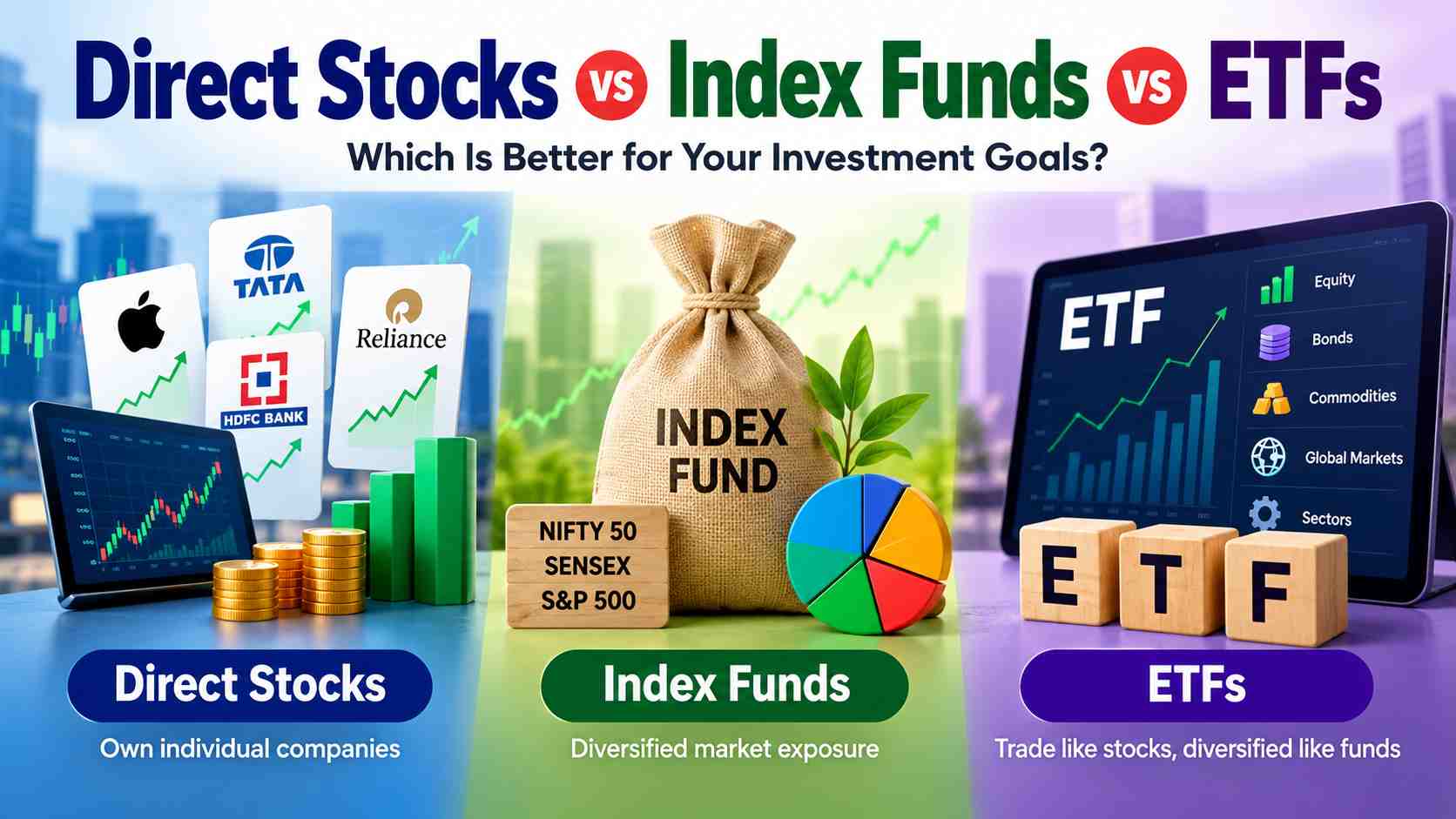
In this guide, you will learn how these three investment options compare, their advantages and disadvantages, their costs, and how to decide which approach fits your financial goals.
What Are Direct Stocks?
Direct stocks are shares of individual companies purchased through a stockbroker. When you buy a company’s shares, you acquire an ownership interest in that business.
For example, an Indian investor might purchase shares of companies listed on the National Stock Exchange (NSE) or Bombay Stock Exchange (BSE). A US investor might buy shares listed on exchanges such as Nasdaq or the New York Stock Exchange (NYSE).
Your investment’s performance depends on factors such as company earnings, business strategy, industry conditions, competition, interest rates, and overall market sentiment.
Also Read: How to Invest $100 or ₹10,000 in Stocks in 2026: A Beginner’s Guide
Advantages of Direct Stocks
1. Greater control over your portfolio
You choose which companies to buy, how many shares to hold, and when to sell. This flexibility can appeal to investors who enjoy researching businesses.
2. Potential for strong individual returns
A successful company may outperform the broader market over a particular period. Investors who identify promising businesses early may benefit substantially, although identifying future winners consistently is difficult.
3. Choice of investment strategy
You can focus on growth companies, dividend-paying businesses, value stocks, or particular industries according to your objectives and risk tolerance.
4. Direct exposure to individual businesses
You can analyze company financial statements, competitive advantages, management decisions, and long-term growth prospects instead of relying on a fund’s selection or index methodology.
Disadvantages of Direct Stocks
1. Higher company-specific risk
If a company experiences financial problems, loses market share, or suffers a major business setback, its share price may fall sharply. You could lose a substantial portion of your investment.
2. Research takes time
Responsible stock selection requires reviewing financial statements, valuations, business risks, industry trends, and corporate disclosures.
3. Diversification can be difficult
A small portfolio may contain only a few companies. If one holding performs poorly, it can have a significant impact on your overall wealth.
4. Emotional decisions can hurt returns
Investors may buy during market excitement or sell during temporary declines. Frequent trading can also increase transaction costs and taxes.
Direct stocks may suit investors who have the time, knowledge, and discipline to research businesses and manage company-specific risk.
What Are Index Funds?
An index fund is a mutual fund or similar investment fund designed to track the performance of a particular market index. Instead of attempting to outperform the market through frequent security selection, it generally follows a predefined index methodology.
Examples include funds tracking the Nifty 50 or Sensex in India and the S&P 500 or Nasdaq-100 in the United States. These indexes represent different groups of securities and have different eligibility rules and concentrations.
When you invest in an index fund, your money provides exposure to a basket of securities. This can reduce the impact of poor performance by a single company compared with holding only that company’s shares. However, diversification does not eliminate market risk.
Advantages of Index Funds
1. Broad diversification
An index fund can provide exposure to many companies through one investment. The level of diversification depends on the index being tracked.
2. Simple investment process
You do not need to choose every individual stock. You select a suitable fund and follow a long-term investment plan.
3. Potentially lower costs
Many traditional index funds use passive management, which can result in lower expenses than some actively managed funds. Actual costs vary by fund, provider, and share class.
4. Suitable for regular investing
Many mutual funds allow investors to invest a fixed amount regularly. In India, this is commonly done through a Systematic Investment Plan (SIP). Regular investing can encourage discipline, but it does not guarantee profits or protect against market losses.
5. Less company-level monitoring
You generally do not need to research every company in the index. You should still review the fund’s costs, tracking performance, investment objective, and suitability for your goals.
Disadvantages of Index Funds
1. You will not avoid market declines
If the index falls significantly, the fund will generally fall as well, subject to fees and tracking differences.
2. Limited control over individual holdings
You cannot usually remove a particular company from a standard index fund yourself. Holdings are determined by the index methodology and fund implementation.
3. Returns generally follow the index
An index fund is designed to track its benchmark rather than consistently outperform it. Its actual return may differ because of expenses, cash holdings, taxes, and tracking error.
4. Different funds have different rules
Two funds that sound similar may track different indexes, use different investment methods, or carry different costs. Investors should read the fund documents before investing.
Index funds may be especially useful for beginners who want diversified market exposure without having to select individual stocks.
What Are ETFs?
An exchange-traded fund (ETF) is an investment fund whose shares trade on a stock exchange. ETFs can hold stocks, bonds, commodities, or other assets, depending on their investment objectives.
Many popular ETFs track market indexes, making them similar to index mutual funds. However, not every ETF is an index fund. Some ETFs follow active strategies, while others track specific sectors, commodities, or investment themes.
For example, an investor may buy an ETF tracking the Nifty 50 in India or an ETF tracking the S&P 500 in the United States. Instead of purchasing every company individually, the investor gets exposure through a single exchange-traded investment.
Advantages of ETFs
1. Diversification through one investment
A broad-market ETF can provide exposure to multiple companies. However, sector-specific ETFs may be concentrated in a particular industry.
2. Trading flexibility
ETFs can generally be bought and sold during exchange trading hours at prevailing market prices. This flexibility can be useful for investors who want control over the timing of their transactions.
3. Transparent pricing
ETF market prices change throughout the trading day. Investors can typically see current quotes and place different types of orders through their broker, depending on the broker’s facilities.
4. Access to different markets
ETFs cover domestic and international equities, bonds, commodities, and various market sectors. The available options depend on the investor’s country, regulations, and brokerage access.
5. Potentially competitive costs
Many broad-market ETFs have relatively low ongoing expenses. However, investors should also consider brokerage charges, bid-ask spreads, and other transaction costs.
Disadvantages of ETFs
1. Brokerage and trading costs
Buying and selling ETFs may involve brokerage charges, taxes, and exchange-related costs. These can matter particularly when making frequent or small transactions.
2. Bid-ask spreads
The buying price and selling price may differ. A wide spread can increase the effective cost of entering or leaving an investment.
3. Market price can differ from underlying value
An ETF’s market price may trade above or below its net asset value (NAV). This difference is often limited for liquid, well-functioning funds but can become more significant in certain market conditions.
4. Temptation to trade frequently
Because ETFs trade like shares, some investors may trade them too often. Frequent trading can undermine a long-term strategy and increase costs.
5. Not all ETFs are simple investments
Leveraged, inverse, narrow-sector, and other specialized ETFs may carry additional risks. Beginners should understand an ETF’s structure before investing.
ETFs may suit investors who want diversified exposure with the convenience of exchange trading and who understand how to manage trading costs.
Direct Stocks vs Index Funds vs ETFs: Key Differences
The following table summarizes the main differences between the three investment approaches.
| Feature | Direct Stocks | Index Funds | ETFs |
|---|---|---|---|
| What you own | Individual company shares | Units in an index-tracking fund | Shares or units in an exchange-traded fund |
| Diversification | Depends on the number of stocks | Depends on the tracked index | Depends on the fund’s holdings |
| Research required | High for responsible stock selection | Fund selection and periodic review | Fund selection and periodic review |
| Trading | Exchange trading hours | Usually purchased or redeemed through the fund | Exchange trading hours |
| Pricing | Market price | Applicable NAV | Market price |
| Costs | Brokerage, taxes, and applicable charges | Expense ratio and applicable costs | Expense ratio, spreads, brokerage, and applicable costs |
| Investment control | High | Limited to fund choice | Limited to fund choice |
| Company-specific risk | Can be high | Generally reduced by diversification | Generally reduced by diversification |
| Regular investing | Possible, subject to broker facilities and share prices | SIPs commonly available in India | Recurring purchases may be available through brokers |
| Beginner suitability | Requires research and discipline | Often suitable for long-term investors | Often suitable for long-term investors |
Remember that index funds and ETFs are not necessarily competing investment strategies. An ETF can itself be an index-tracking fund. The practical comparison is often between individual stocks, index mutual funds, and index-tracking ETFs.
Index Funds vs ETFs: Which Is Better?
This comparison deserves particular attention because both investment options can track the same index.
Suppose two investments track the Nifty 50. One is an index mutual fund, and the other is an ETF. Their underlying market exposure may be similar, but their purchase methods, costs, and day-to-day operations differ.
Choose an Index Mutual Fund If:
- You prefer a straightforward, long-term investing routine.
- You want to invest a fixed amount regularly through a SIP.
- You do not want to place exchange orders or monitor bid-ask spreads.
- You prefer purchases and redemptions at the applicable NAV.
Consider an ETF If:
- You have a suitable brokerage and demat account in India, where required.
- You want to trade during market hours.
- You can compare liquidity, bid-ask spreads, and expense ratios.
- You prefer exchange-based transactions and can manage order execution.
Neither option is automatically better. Compare the fund’s expense ratio, tracking difference, tracking error, liquidity, tax treatment, and convenience before deciding.
Which Investment Is Better for Beginners in India?
For many beginners in India, a diversified, low-cost index mutual fund can be a practical starting point. It offers a relatively simple way to participate in the stock market without requiring extensive company-by-company research.
An investor who wants to track a broad Indian equity index might compare funds tracking the Nifty 50 or Sensex. Those seeking broader exposure should examine the index methodology and holdings rather than assuming that every index fund covers the entire market.
ETFs may be an equally reasonable choice for beginners who understand exchange trading and can evaluate liquidity and transaction costs.
Direct stocks can also play a role, but beginners should recognize that choosing individual companies requires more research and exposes them to company-specific risks.
Example: Investing ₹10,000
Imagine you have ₹10,000 available for long-term equity investing.
Option 1: Direct stocks
You purchase shares of one or more companies. Your outcome depends heavily on the businesses you select, their valuations, and how they perform.
Option 2: Index mutual fund
You invest ₹10,000 in a suitable index mutual fund. Your money gains exposure to the index’s portfolio, subject to the fund’s tracking and expenses.
Option 3: Index ETF
You purchase units of an index-tracking ETF through a broker. Your actual investment amount depends on the unit price, order execution, and applicable costs.
These options cannot be ranked by return in advance. The result depends on market performance, investment selection, costs, and the period you remain invested.
For a beginner who wants simplicity, the index mutual fund may be easier to manage. An ETF can offer similar index exposure, while direct stocks require greater attention to individual businesses.
What About Investing in the US Stock Market?
US investors face a similar choice between individual stocks, index mutual funds, and ETFs.
For example, an investor might buy individual US-listed companies, invest in a mutual fund tracking the S&P 500, or purchase an S&P 500 ETF.
A broad-market fund can help spread company-specific risk across multiple holdings. However, an index’s performance is not guaranteed, and different indexes can have significantly different concentrations and sector exposures.
Investors based in India who want exposure to US markets should also consider foreign-exchange movements, applicable Indian regulations, fund availability, taxation, and the costs of international investing. Access to particular US-listed securities or funds depends on current rules and the investor’s circumstances.
Do not assume that an investment is suitable simply because it tracks a well-known index. Review the product’s domicile, fees, holdings, risks, and tax implications.
Costs, Taxes, and Risk: What Should You Compare?
Before investing in any of these options, review the following factors.
Expense ratio: The annual operating expense charged by a fund. A lower expense ratio can help reduce costs, but it is not the only measure of fund quality.
Tracking difference: The difference between a fund’s return and its benchmark return over a specified period. Tracking difference helps show how closely the investment has followed its benchmark after relevant costs.
Tracking error: A measure of the variability of the difference between fund returns and benchmark returns. It provides additional information about tracking consistency.
Liquidity: Particularly important for ETFs, because trading volume and bid-ask spreads can affect execution costs.
Taxation: Tax rules depend on your country, residency, investment type, holding period, and applicable law. Indian equity investments, debt funds, ETFs, and overseas investments can have different tax treatment. Verify current rules before making decisions.
Risk tolerance: Direct stocks may expose you to concentrated company risk, while diversified funds still carry market risk. Your choice should reflect your ability and willingness to tolerate losses.
Time horizon: Equity investments can be volatile over short periods. Money needed soon for essential expenses is generally not appropriate for high-risk equity exposure.
Can You Combine Direct Stocks, Index Funds, and ETFs?
Yes. You do not necessarily need to choose only one investment type.
Some investors use a diversified index fund as their core equity holding and allocate a smaller portion of their portfolio to individual companies they have researched. Others prefer to use an ETF for their core exposure because of its trading flexibility.
A sensible allocation depends on your financial goals, existing investments, income stability, time horizon, and risk tolerance. There is no universally correct percentage to allocate to each option.
Avoid buying several funds that hold nearly identical investments without understanding how much overlap exists. More investments do not automatically mean better diversification.
Before investing, build an emergency fund, address expensive debt, and make sure you can afford to keep your equity investments invested through market downturns.
Common Mistakes to Avoid
- Choosing investments based only on recent returns. Strong past performance does not guarantee future results.
- Ignoring total costs. Expense ratios, spreads, brokerage charges, and taxes can reduce net returns.
- Confusing an ETF with an index. An index is a measurement or rules-based portfolio; an ETF is an investment vehicle.
- Concentrating too much in one company or sector. Concentration can increase losses when that investment underperforms.
- Trading emotionally. Short-term price movements can tempt investors to abandon a suitable long-term plan.
- Investing money needed for near-term expenses. Market declines may force you to sell at an unfavorable time.
- Assuming diversification guarantees profits. Diversification can reduce some risks, but it cannot prevent losses during a broad market decline.
Frequently Asked Questions (FAQs)
1. Are index funds better than direct stocks?
Index funds may be more suitable for investors who want diversified market exposure without researching individual companies. Direct stocks offer more control but require research and carry company-specific risks. The better choice depends on your experience, goals, and risk tolerance.
2. Are ETFs safer than individual stocks?
A diversified ETF may reduce the risk associated with any one company compared with holding only that company’s shares. However, an ETF concentrated in one sector or using leverage can be risky. ETFs can also lose value when their underlying investments decline.
3. Can I invest in index funds with ₹500?
Some Indian index mutual funds may permit investments starting at ₹500, although minimums vary by fund and investment method. Check the scheme documents and current minimum investment requirements.
4. Do index funds guarantee returns?
No. Index funds are exposed to the movements of their underlying markets. They can lose value, and past performance does not guarantee future returns.
5. Is an ETF the same as an index fund?
No. An ETF is a fund traded on an exchange, while an index fund is defined by its objective of tracking an index. Many ETFs are index-tracking funds, but some ETFs use active strategies or track other types of assets.
6. Should beginners invest in direct stocks or ETFs?
Beginners seeking diversified market exposure may find a broad-market index fund or ETF easier to manage than a portfolio of individual stocks. The choice between the two depends on transaction costs, convenience, liquidity, and investing preferences.
7. Can I invest in both Indian and US markets?
Depending on your country of residence, eligibility, and applicable regulations, you may be able to obtain exposure to both markets. Indian residents should verify current rules, available products, foreign-exchange costs, and tax implications before investing overseas.
Official Sources and Further Reading
- SEBI Investor — Factors to Consider Before Investing
- Investor.gov — Beginner’s Guide to Asset Allocation and Diversification
- Investor.gov — Stocks: Frequently Asked Questions
- SEC EDGAR — Company Filings
- NSE India
- BSE India
- Reserve Bank of India
- Internal Revenue Service
Conclusion
The choice between direct stocks, index funds, and ETFs depends on how you want to invest and manage risk.
Direct stocks provide control over individual company investments but require more research and expose you to company-specific risks. Index mutual funds offer a straightforward way to obtain diversified market exposure and may be convenient for regular investing. ETFs can provide similar diversification with exchange-trading flexibility, although liquidity and trading costs deserve attention.
For many beginners, a low-cost, diversified index fund is a reasonable option to investigate first. An index ETF may be equally appropriate for someone comfortable with exchange trading, while direct stocks may suit investors who are prepared to research businesses carefully.
The most useful starting point is to establish your financial goals, maintain adequate emergency savings, understand your risk tolerance, and compare the costs and characteristics of the available investments.
Disclaimer: This article is for educational purposes only and does not constitute personalized financial, investment, or tax advice. All investments involve risk, including possible loss of principal. Conduct your own research and consult a qualified professional when appropriate.
Hello guys! My name is David Wilson, and I'm a passionate stock market enthusiast and the founder of 9to5Stock. With a deep understanding of market dynamics and a commitment to empowering others, I share valuable insights, strategies, and updates to help investors like you make informed decisions and achieve financial success. Welcome to our community, and let's thrive together in the world of investing!